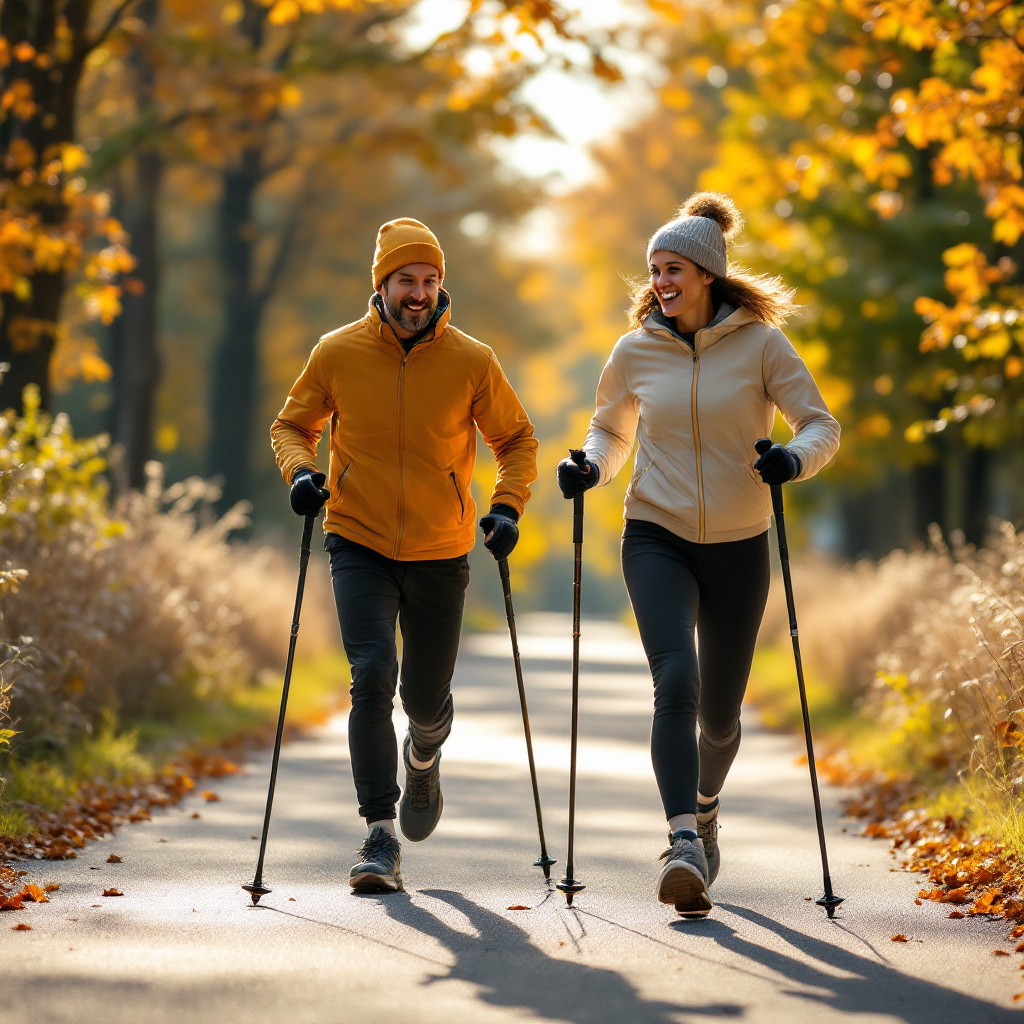
Getting Started
Nordic pole walking is easy to learn — it's simply your natural walk, supported by two poles. Within a few minutes it feels comfortable, and soon you'll settle into an easy rhythm with your whole body in motion. One tip for beginners: don't walk too slowly, or you'll lose the arm swing that makes the technique work.
Your power transfer to the poles. There's a right and a left hand loop. Slip in as though you're shaking hands with the pole, then adjust the Velcro strap until it feels comfortable. Stretch your arms out and open and close your hands — you'll naturally grasp the grip as you close.
With your elbow and forearm at your side at a 90-degree angle, drop your hands about two inches and take the grip — roughly 65% of your body height. Twist the upper and lower sections in opposite directions to set it, and lock them tight.
On hard surfaces use the rubber tips; on soft ground take them off and use the carbide tips underneath.
Watch our technique videos to see Nordic pole walking in action.
Questions about getting started or choosing the right poles? Check out the FAQ section on each page for answers.
Shop PolesMultiply your height in centimetres by 0.68. With your arm relaxed at your side, your elbow should bend at about 90 degrees. Between sizes, pick the shorter length.
Walk naturally with a slightly longer stride. As one foot steps forward, plant the opposite pole behind you and push back through the hand strap. Keep your posture tall and swing your arms from the shoulders.
No. Comfortable walking shoes and everyday activewear are enough. Use the rubber tips on pavement and the metal tips on trails, grass or snow.
Aim for 30 to 45 minutes, three or more times a week. Because it's low-impact, many walkers build up to daily sessions.